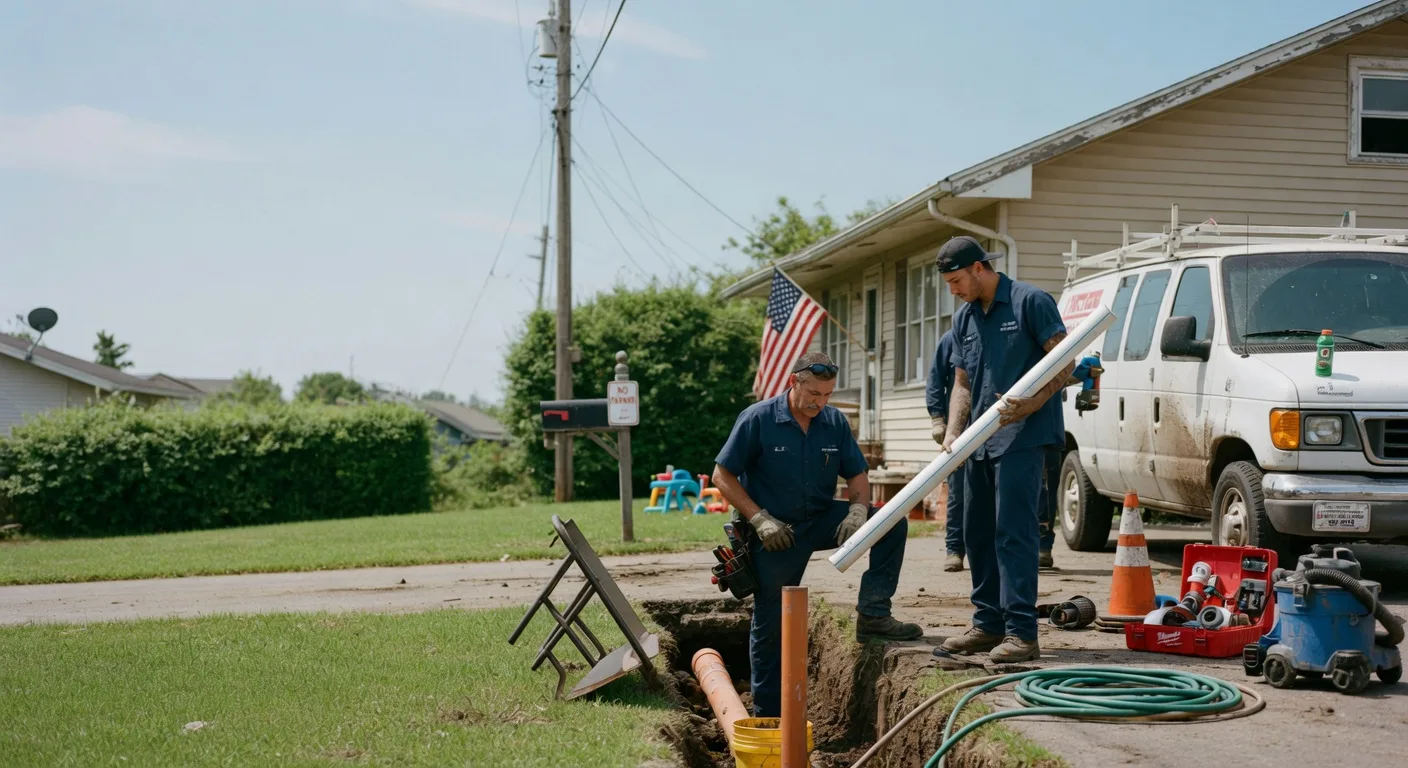
When is a drain backup a plumbing emergency?
Stop running water and call now if water is backing up from more than one drain, sewage is coming up through a floor drain or tub, a toilet overflows on its own, or you smell sewer gas inside the house. Those signs point to a blocked or failed main line. That is a different problem from one slow sink. The main line carries everything the house sends out, so when it stops, water has only one place to go, which is back up through the lowest opening in the house, usually a basement floor drain or a tub. Every load of laundry, dishwasher cycle, or shower adds to the flood, so turning off water use is the most useful thing you can do while you wait. Do not try to clear a full main line yourself; it takes a larger cable or a jetter, and sewage carries bacteria. Keep children and pets out of the affected area. A single slow drain that still empties, or a fixture that gurgles once in a while, can usually wait for a scheduled visit. A backup that is rising, spreading, or coming from several places cannot. Call (380) 262-9173 to be connected with an independent plumber in Standish, CA.
If you decide the situation is serious, a few quick actions will limit the damage. Shut off the washing machine and dishwasher, and ask everyone to hold off on flushing. If water is already on the floor, lift rugs and move belongings out of the way, and keep electrical items and cords clear of wet areas. Do not run a wet vacuum on sewage, and do not wade through it barefoot. Take photos of the water and the affected fixtures, since they help if you later need to describe the problem to an insurer. Open a window for ventilation if the smell is strong. Know where your main water shutoff is, because if a supply line is leaking rather than a drain backing up, that valve is the right one to close. Older homes often have a floor drain that is the first place sewage appears, so check it first.
Two houses share one sewer line. Whose blockage is it?
Your basement drain is backing up and the neighbor says theirs is fine. Or both are backing up and each blames the other. On a shared sewer lateral, that argument is common.
In older terraced or paired properties, two buildings join one lateral before it reaches the main. A blockage downstream of that junction backs up into whichever building sits lower. That is often not the building that caused it. Roots at a clay joint, grease build-up or a bellied line can sit past the junction and still flood one side.
One slow sink is local, and a cable machine usually clears it. Every drain in the building backing up points to the lateral. That calls for a camera inspection, and often hydro jetting.
A camera inspection and a locator establish where the junction is and where the blockage point sits. Distance readings matter: how far from the cleanout to the junction, and to the fault. They show which side of the junction the fault is on.
Responsibility depends on local rules and on where the fault sits. Some places treat the shared section as a joint matter for the owners, others place part of it with the utility. Do not assume. The city or sewer utility can say how it works for a given address.
Safe homeowner check: ask the neighbor if they have symptoms, and hold off on water use. Stop running water and call now if sewage is rising in a tub, shower or floor drain. What a repair involves depends on access, the materials, how much has to be opened up, and any permit or code requirement.
Expert Plumbers Co is a referral service. We refer homeowners in Standish, CA to an independent local plumber for Drain Cleaning and Emergency Drain Cleaning. Call (380) 262-9173.
Before anyone argues about cost, get the facts in hand. Agree with the neighbor to share the camera footage and the distance readings, so both households work from the same picture. Check the property records for any easement or shared-line agreement, since some older properties carry one. Ask the local building department or sewer utility who maintains the section between the junction and the main.
Ask your home insurer whether sewer backup is covered. Many policies treat it as an optional add-on, and a claim usually needs documents.
Once the line is clear, the sensible follow-up is a maintenance plan both sides accept. That might be periodic jetting, or a cleanout fitted at the junction so future blockages can be reached without digging. A cleanout in the right spot turns a future emergency into a short job. Keep the plumber's written findings. They settle most disputes about where the fault sat.
Can a drain under a concrete slab be cleared without breaking the floor?
Usually, yes. Clearing a blockage and repairing a broken pipe are two different jobs, and only the second one needs the floor opened.
In a slab-on-grade house the drain lines run inside or beneath the concrete. There is no crawlspace to inspect, so symptoms are the only evidence you have. A cable or a hydro jetter still reaches the line through a cleanout or through a pulled toilet. Grease build-up on the pipe wall, roots in a joint and scale in cast iron can all be cleared that way.
What does need the floor opened is a cracked, collapsed or bellied section under the slab. A bellied line holds water and collects waste however often it is cleared. In older housing stock where clay or cast iron was the standard, failed sections are more likely.
A camera inspection with a locator pinpoints the fault. The plumber finds the exact spot and marks it on the floor before anything is cut, which keeps the opening small. What the job involves is driven by access, the materials, how much concrete must be opened and removed, and any permit or code requirement. Opening a slab often brings one in.
Safe homeowner check: note whether one fixture is slow or every drain is affected. A single slow fixture is usually a cable job on a branch line. Every drain backing up points to the main line or the sewer lateral.
Stop running water and call now if the whole house is backing up. Report water staining or a warm, damp patch on the floor, because it can mean a leak under the slab.
Expert Plumbers Co is a referral service. We refer homeowners in Standish, CA to an independent local plumber. Call (380) 262-9173.
A spot repair under a slab is more disruption than most people picture. The plumber breaks out a section of concrete, digs down to the pipe, replaces the damaged length, and the floor is patched. Dust, noise and a few days without some fixtures are normal. Furniture and flooring over the area must be moved first, and tile or a finished floor may not match after patching.
For longer runs of damage, some plumbers can line the pipe from inside, or route a new line overhead or outside the house, which avoids cutting the slab. Whether either suits your pipe depends on its condition and on local code.
Ask to see the camera footage and the locator mark on the floor before any cutting begins. Mention in-floor heating, radiant tubing or a post-tension slab if you have one. Cutting into those without knowing is dangerous, so the plumber needs to hear about them before a saw comes out.
Is this a water supply problem or a drain problem?
Water that will not leave is a drain problem. Water that arrives wrong is a supply problem.
Supply problems show up as weak pressure, water that runs hot or cold when it should not, a meter that keeps turning, or a wet spot where the water is clean. Drain problems show up as water that will not go down, gurgling, a sewer smell, or dirty water coming back up through a tub or floor drain. A jump in the water bill points to supply, not drainage.
A wet patch in the yard can be either. The giveaway is the water itself. Clean and odorless points to a supply leak. Gray, dark or smelly points to a drain, often a failed sewer lateral or a root-damaged joint.
Safe homeowner check: shut off every fixture and appliance, then look at the meter dial. If it still turns, water is escaping somewhere. Next, run one drain at a time and note which ones are slow.
One slow fixture is its own branch line, and a cable machine often clears it. Several fixtures slow together point to the main line or a blocked vent stack. A repeat problem can need a camera inspection or hydro jetting instead of a cable.
Stop running water and call now if sewage is coming up in a tub or floor drain, if every drain in the house is backing up, if a clean leak will not stop, or if water is near electrical equipment.
What the work involves depends on access, the pipe materials, how much has to be opened up, and any permit or code requirement. Expert Plumbers Co is a referral service. Call (380) 262-9173 and we will refer you to an independent local plumber in Standish, CA.
Two cases fool people. The first is a toilet that keeps refilling. It wastes supply water, yet it can look like a drainage fault because water is always moving. Listen for a hiss when the house is quiet, then put a little food coloring in the tank. Color in the bowl without flushing points to a worn flapper.
The second is a hot water line leaking under a slab. Signs include a warm patch on the floor, a water heater that seems to run constantly, or the sound of water with every fixture off. That is a supply problem and needs a different approach from drain cleaning.
Pressure tells you something as well. Low pressure on hot water only points at the water heater or its valves. One weak fixture often means a clogged aerator or a partly closed shutoff, usually from mineral scale. Note which case fits before you call, so the right tools and parts come with the plumber.
Our cabin or second home sat empty for months and now the drains smell and run slowly. Why?
You open the cabin for the first time in months and the drains smell like a sewer and the water creeps away.
Every fixture has a trap, the curved section that holds a little water to block sewer gas. With no use, that water evaporates. Once the seal is gone, gas comes straight up the drain. The film left in the pipe also changes while the house sits. Soap, grease and food residue dry and harden on the pipe wall, so the first heavy use narrows the line and water slows down. Then there is the line itself. A vacant house can still have roots working into a clay or cast iron joint, and nobody was flushing them back with daily flow.
If one sink or tub is slow and the others are fine, the problem is probably local to that fixture, its trap or its branch line. If every drain is slow, several fixtures gurgle, or the toilet bubbles when you run the washer, the blockage is further down, in the main line or the lateral to the street.
Safe homeowner check: run water in every fixture for a couple of minutes, including rarely used ones, to refill the traps. Pour a cup of water into floor drains. If the smell fades and the flow picks up after a day or two of normal use, dried traps and loosened residue were likely the whole story.
Stop running water and call now if wastewater comes up in a tub, shower or floor drain, if the toilet will not clear, if the smell stays strong after the traps are filled, or if you see wet floors, stained ceilings or sagging drywall.
A cable machine is enough when the clog is residue or a soft plug in one branch. If the line stays slow after cabling, if roots are suspected, or if grease has coated the full pipe wall, the plumber will usually recommend hydro jetting, which scours the pipe wall with high pressure water. A camera inspection settles the question of roots, a belly holding water, or a failed lateral.
Expert Plumbers Co is a referral service. We connect you with an independent local plumber in Standish, CA. Call (380) 262-9173.
Before you book, tell the plumber how long the house sat empty, whether it was winterized, and which drains are affected. Ask whether they plan to cable, jet or run a camera first, and what they will do if the camera shows roots or a damaged section. The scope depends on access to the line, the parts or pipe needed, how much has to be opened up, and whether a permit or code step applies to a repair.